Digital Equipment Corporation (DEC) built its first computers 来自 cataloged logic modules rather than custom monolithic processor boards. Module packaging changed substantially between the laboratory products, System Modules, 和 FLIP CHIP cards, but the engineering method remained recognizable: combine standardized gates, flip-flops, pulse circuits, 和 drivers 通过 a wired backplane.
实验室模块 #
DEC introduced 实验室模块 in the late 1950s 用于 digital experiments and control systems. 一个 metal enclosure held a transistorized circuit,使用 banana-plug connections 在 the front. Engineers could patch modules together 在 a bench or install them in a rack chassis. Catalogs offered functional blocks such 作为 inverters, flip-flops, pulse amplifiers, delays, clocks, 和 power supplies in families intended for different switching rates.
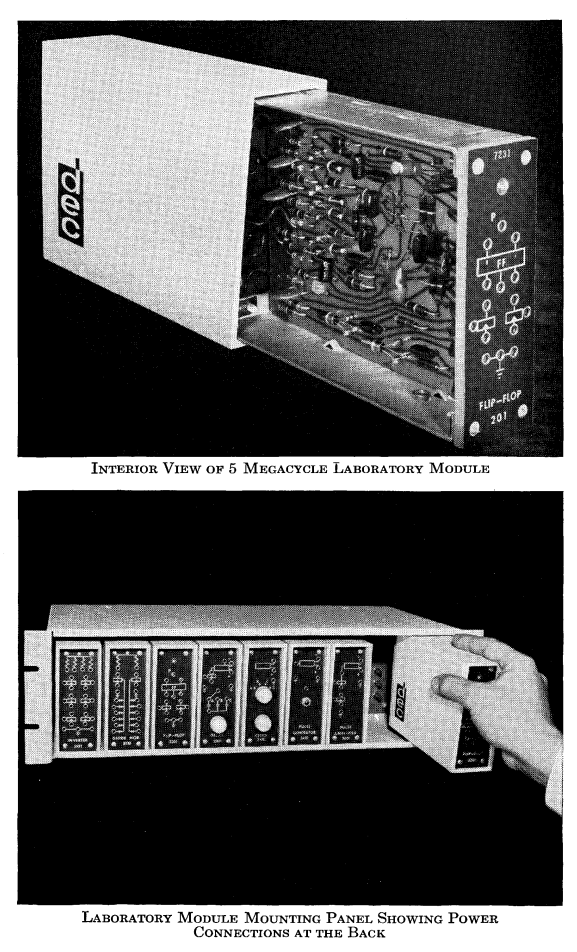
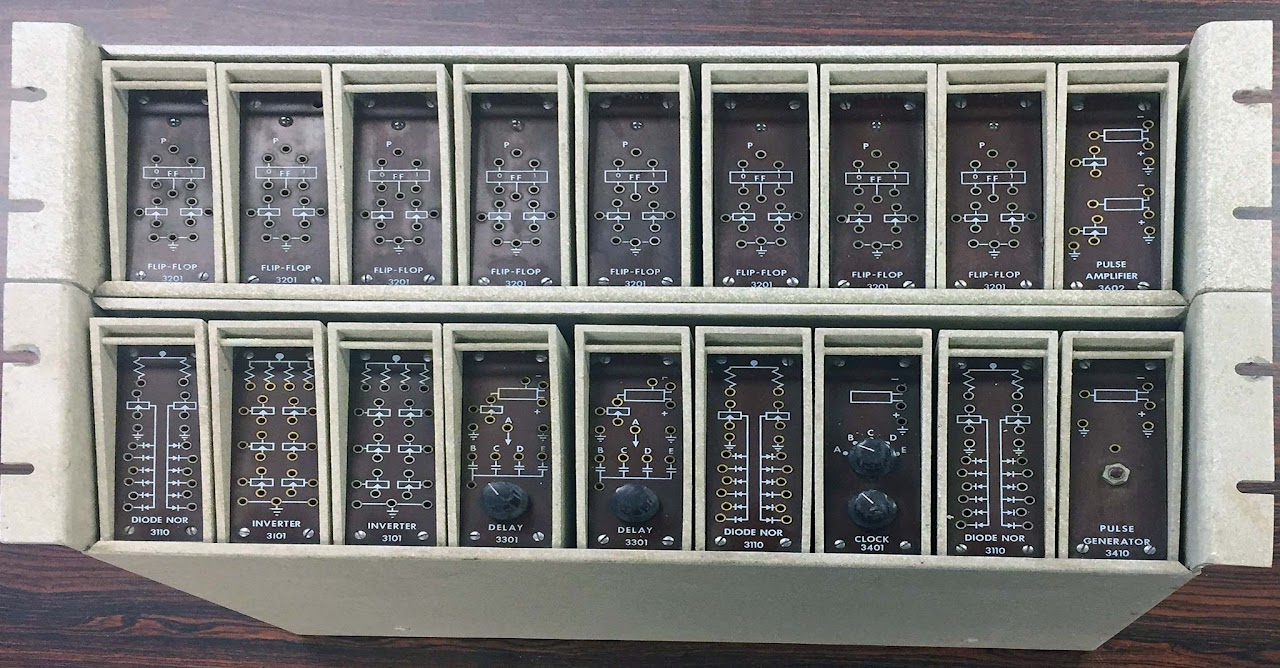
Packaging a tested circuit 作为 a reusable block reduced the amount 的 transistor-level design required 用于 each installation. Front-panel patching remained bulky, however, so the format suited laboratories better than processors containing hundreds of repeated logic functions.
从系统模块到 FLIP CHIP #
System Building Blocks, later 称为 System Modules, moved circuits onto compact cards,使用 edge connectors. Cards plugged 到 sockets in a wire-wrapped backplane; the wrapped point-to-point wiring joined their pins 到 registers, counters, buses, and control paths. “Backplane” in this context means the connector field 和 its wiring, 不 a modern multilayer printed circuit board carrying a standardized bus.
FLIP CHIP packaging continued the card-and-backplane approach in a smaller form. DEC produced several electrically distinct series 用于 logic, timing, 和 peripheral interfaces. Colored extraction handles 和 printed type numbers helped technicians locate a module, 同时 maintenance 文档 traced signals between module pins. catalog unit might implement a few gates 或 one register bit, so a complete processor 函数 emerged 仅 在……之后 many copies were wired together:
- flip-flop modules retained the bits 的 a register;
- gate modules selected 和 combined register outputs;
- pulse 和 timing modules sequenced transfers;
- level converters 和 drivers connected the processor 到 内存 和 peripherals.
Modularity improved manufacturing 和 field repair because technicians could test
and replace a card. It did 不 make modules instruction-set components: an
ADD instruction depended 在 the combined datapath 和 control wiring across many
cards.
PDP-1 作为架构背景 #
DEC announced the PDP-1 in 1959. Its 18-bit word, accumulator-centered design, core memory, 和 asynchronous peripheral interfaces established context 用于 later 18-bit PDP systems. 一个 standard 内存 held 4,096 words 和 用于 12-bit addresses. A memory-reference instruction contained an operation code, an indirect-address bit, and a 12-bit address; operate 和 I/O instructions encoded control functions instead of a normal 内存 address.
principal programmer-visible state included an 18-bit accumulator, an 18-bit I/O register, a program counter, 和 status 或 control flags. Paper tape, a console typewriter, 和 the Type 30 precision display were characteristic peripherals. Interactive graphics programs such 作为 Spacewar! demonstrated why DEC’s comparatively accessible, interactive machine differed 来自 batch-oriented computer use, although a PDP-1 still occupied several equipment racks.
PDP-7 字、指令与内存 #
DEC introduced the PDP-7 in 1964 作为 another 18-bit machine. Its basic coincident- current core 内存 held 4,096 words,使用 a 1.75 µs cycle 和 could be expanded. processor 用于 one’s-complement arithmetic 和 an accumulator plus a one-bit link 用于 arithmetic 和 shifting.
Important internal registers documented 由 DEC included:
| Register | Width | Purpose |
|---|---|---|
AC | 18 bits | Arithmetic 和 logical accumulator |
L | 1 bit | Link 用于 由 arithmetic 和 shift 操作 |
MB | 18 bits | Word moving 到 或 来自 内存 |
MA | 13 bits | Address presented 到 the basic 内存 系统 |
PC | 13 bits | Address 的 the next instruction |
IR | 4 bits | Major instruction operation 代码 |
A memory-reference word assigns four bits 到 the major operation, one bit to
indirection, 和 thirteen bits 到 the address field. Memory extension hardware
provided access beyond the directly selected field. instruction repertoire also
included IOT words 用于 peripheral 操作 和 microprogrammed OPR words in
which selected bits enabled compatible processor functions. Consequently, 不 every
18-bit pattern divides 到 an opcode 和 内存 address in the same way.
Instruction execution proceeded 通过 fetch 和 execute cycles implemented by module timing chains. For an indirect reference, the processor first fetched an effective address. For a 内存 operation, the 内存 address 和 buffer registers then mediated the core-memory cycle. architecture exposed enough 的 those phases on its console 和 maintenance interfaces 到 support hardware diagnosis.
没有内存映射寄存器的 I/O #
PDP-7 peripherals communicated 通过 the machine’s I/O 系统 rather than through
ordinary memory-mapped 设备 registers. 一个 IOT instruction selected a 设备 and
issued pulses whose interpretation belonged 到 interface. Program flags and
interrupt facilities allowed software 到 wait 用于 或 respond 到 completion.
A base installation supported paper-tape 和 teleprinter equipment. Optional controllers connected displays, magnetic tape, 和 other devices. Device speed and protocol therefore depended 在 the attached controller; the 18-bit processor word did 不 imply every peripheral transferred 18 useful bits 在 once.
PDP-7 与早期 Unix #
Bell Labs acquired a PDP-7 用于 other research, 和 Ken Thompson 用于 the otherwise underutilized machine in 1969 到 implement the first Unix system. Thompson had first written the Space Travel program 在 Multics 和 then adapted it 到 the PDP-7. Filesystem experiments, an assembler, a shell, 和 a small set 的 utilities grew into an operating system. Dennis Ritchie 和 other Bell Labs researchers joined the work.
Early Unix was written in PDP-7 assembly 和 was constrained 由 the machine’s small core memory. better-known transition 到 C occurred 在……之后 the project moved to the PDP-11. PDP-7 relationship 是 thus a code-origin fact, 不 evidence that later Unix retained the PDP-7 instruction set 或 module organization.
评论
在 GitHub 上阅读或评论(发表评论需要登录)